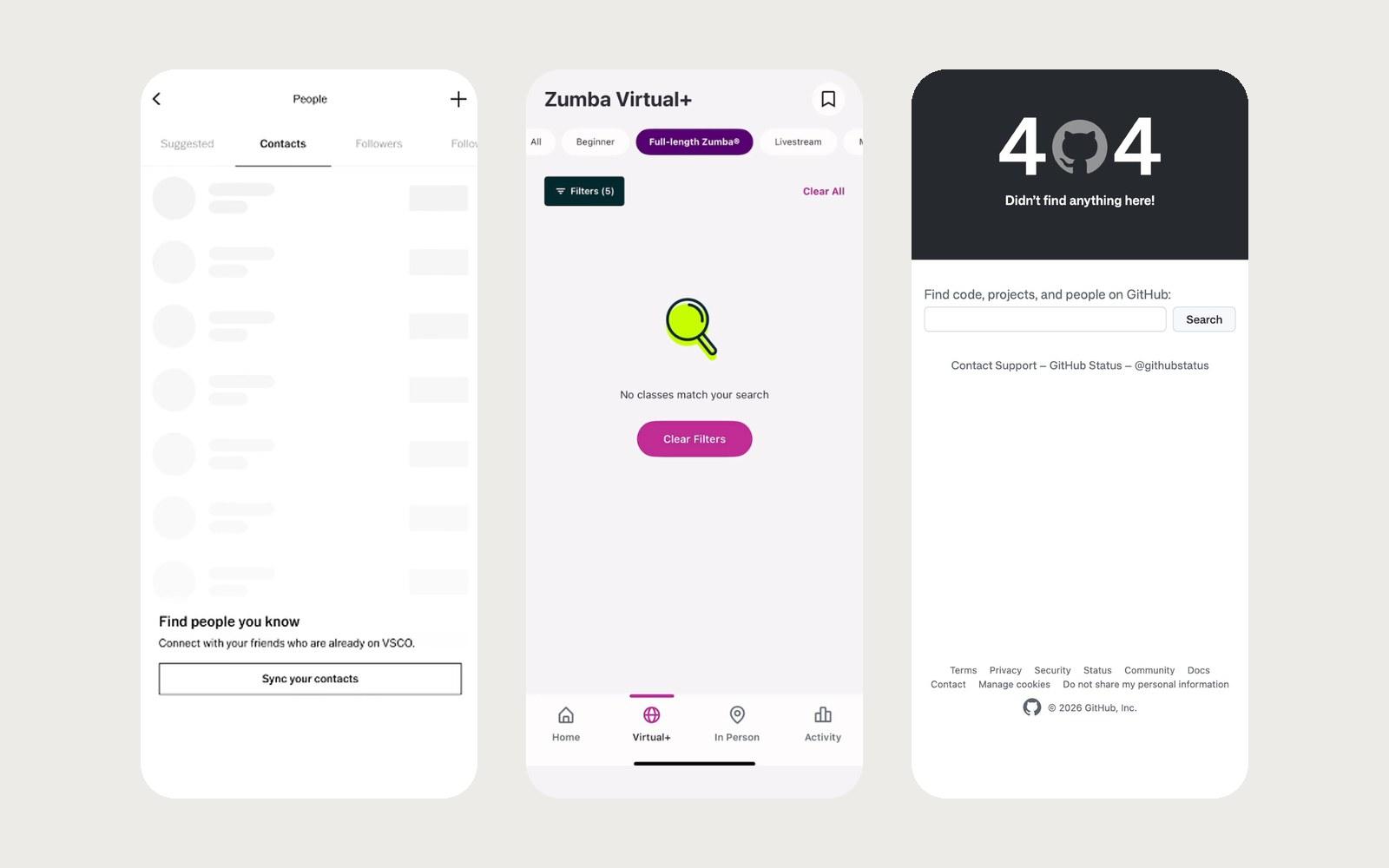
AI tools can take you from an idea to a working screen in an afternoon. They don't promise anything you didn't ask for.
AI is probabilistic. Ask for the same feature twice and you get two different versions, each filling the gaps with its own best guess. It builds the happy path, the version where everything works, because that is what the request describes. Access rules, empty and error states, safe key handling, clear errors and a plan for launch day show up only when the model happens to think of them.
Those are the five gaps we see most in AI-built apps: security, app states, secrets, error handling and deployment. All five have the same cause: nothing written down said what "done" means.
So the fix for all five is one method. Below is how it works, how one spec closes each gap, and what founders, designers and builders each own in it. The screens are real, captured on 15 November 2026 and credited under each image.
1. From better prompts to systems
A prompt is a request. A system is a set of rules that still holds tomorrow, for the next feature, in the next session, whichever model you use.
Most people respond to a bad AI result with a better prompt. That helps once. The next session starts from zero, the model guesses again, and the rule you typed last week is gone. You can't review a prompt you no longer have, and you can't check an app against a conversation.
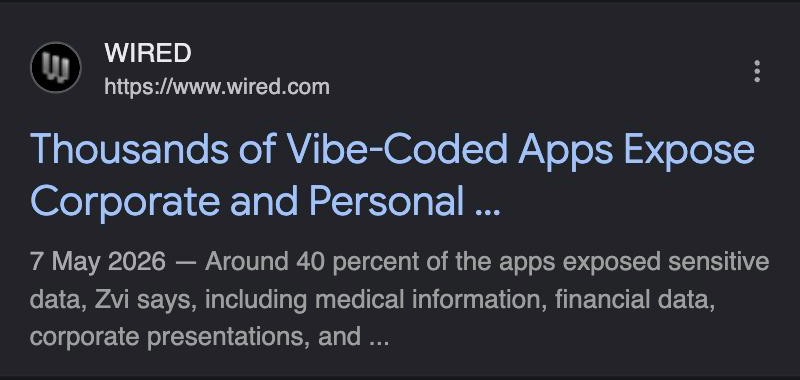
Real capture: Google search results for "vibe coded apps exposed", 15 November 2026. The story is WIRED's.
In May 2026 the security firm RedAccess reported about 380,000 publicly accessible apps, databases and related assets built with Lovable, Base44, Replit and Netlify (VentureBeat). More than 5,000 of them had next to no security or authentication at all (WIRED), and the exposed data included hospital doctor-patient summaries.
An open database is rarely what anyone asked for. It's what you get when nothing says it has to be closed.
If your next session started from zero, which rules would your app still follow?
2. A spec is code in a higher-level language
A spec is that system, written down. Think of it as code in a higher-level language: plain sentences that the AI compiles into the lower-level code your app runs on.
Like code, a spec is exact about what must be true. Unlike code, everyone on the team can read it. It answers five questions:
- Who is it for, and what does it do? One or two sentences.
- What must always be true? The rules, such as "only the owner can read their orders".
- What happens when something fails? Every failure the user can hit, and what they see.
- What must never happen? No key in the browser. No double charge.
- How do we check it? A test for each rule, written before the build.
Then the work runs in one loop: write the spec, plan it, split the plan into tasks, let the AI build, and check the result against the spec. When the result is wrong, you fix the spec or the code, never just the prompt. Rules that apply to every feature, like "no key in the browser", go in one project-wide file the AI reads every session.
That loop is called spec-driven development. You can start looking into it through GitHub Spec Kit, an open-source toolkit that gives AI coding agents a ready-made spec-driven process: a specification carried through a plan, tasks and working code.